Rest2Art

Articulated Object Reconstruction from Rest-State Observation

Seoul National University
*Indicates Equal Contribution
ECCV 2026
Rest2Art teaser

We propose Rest2Art, an approach for reconstructing articulated objects with part-level geometry and joint parameters from rest-state observations alone.

Abstract

Building interactive digital twins requires recovering both 3D geometry and the kinematic structures that govern how objects articulate. Yet existing methods for articulated object reconstruction require explicitly observable motion from multiple articulation states. We introduce a rest-state formulation that reconstructs articulated objects from a single closed configuration, an inherently ill-posed setting where geometry, semantics, and motion priors compensate for the absence of motion cues. Our framework adopts an explicit mesh as an intermediate representation for cross-model verification and fusion, reconciling noisy outputs from vision-language and segmentation models into spatially consistent part structures. To estimate joint parameters without observed motion, we use a video diffusion model to synthesize articulation hypotheses and validate them through geometric consistency. Our approach achieves accurate part decomposition and physically plausible articulation, performing competitively with motion-observing reconstruction-based, generation-based, and modular pretrained-model baselines.

Method

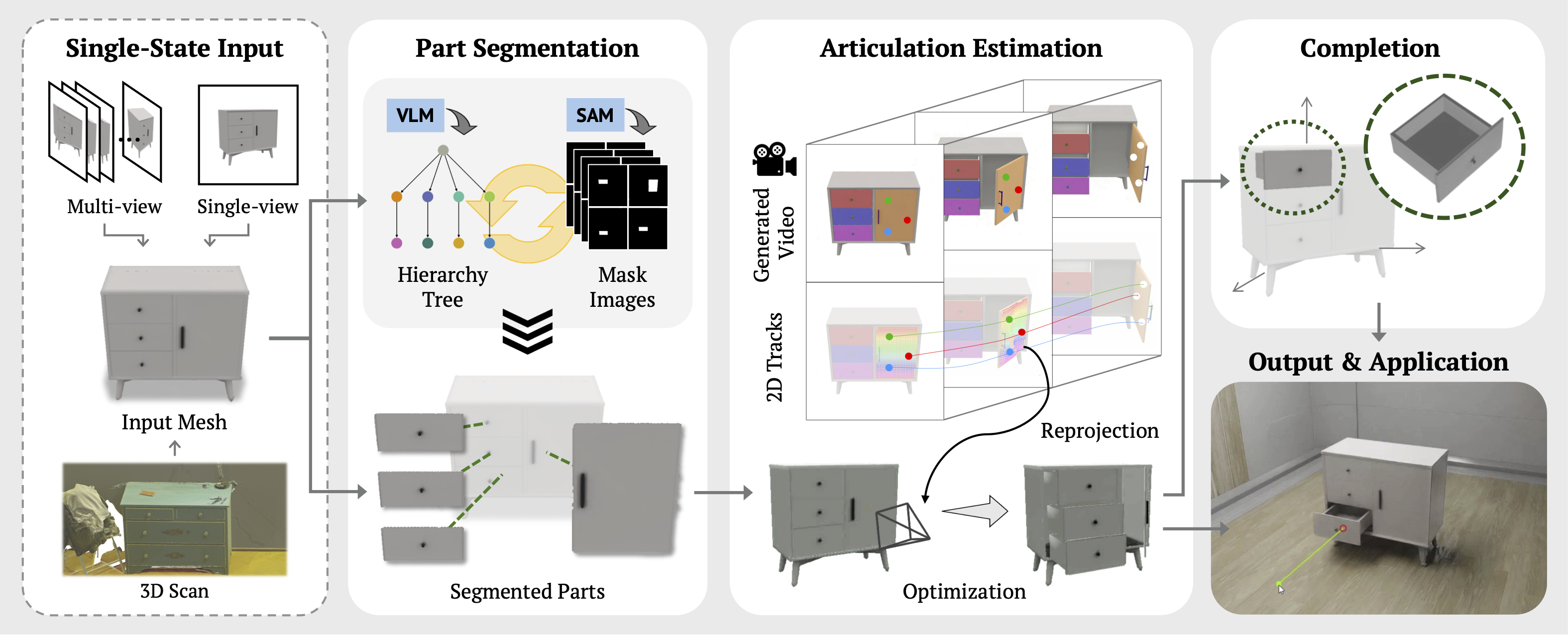
Rest2Art method overview

Rest2Art reconstructs articulated objects from rest-state inputs in three stages. Given an initial mesh (from multi-view captures, single-image generation, or 3D scans), we (i) co-refine part hierarchies and segmentation masks by using disagreements between a vision-language model and a segmentation model as a signal for mutual correction, then lift validated evidence onto the mesh through confidence-weighted aggregation; (ii) estimate joint parameters by synthesizing articulation videos with a video diffusion model, extracting 2D point trajectories, and fitting rigid-body joint models grounded in the mesh geometry; and (iii) complete each part into a volumetric mesh suitable for physical simulation.

Interactive Results

Reconstructed articulated objects. Drag to rotate, scroll to zoom. Pick an object below, then play its articulation.

3D model placeholder — add a .glb to ./static/models/

Applications

Policy Learning

Reconstructed articulated objects augment manipulation-policy training data (e.g., laptop-lid opening, container lifting). Placeholder for task demos.

Task demo 1 (GIF/video)

Laptop lid opening

Task demo 2 (GIF/video)

Container lifting

Real-to-Sim-to-Real

Real objects are reconstructed, converted to articulated assets, simulated, and executed on hardware. Placeholder for side-by-side sim / real videos.

Simulation (video)

In simulation

Real robot (video)

On hardware

BibTeX

@inproceedings{lee2026rest2art,
  title={Articulated Object Reconstruction from Rest-State Observation},
  author={Lee, Daeun and Lee, Jaeah and Kim, Woosung and Jung, Haebeom and Park, Jaesik},
  booktitle={European Conference on Computer Vision (ECCV)},
  year={2026}
}